
Indigenous Fine Art
Preserving a Rare
Indigenous Art Form
Handcrafted Moose Hair & Caribou Hair Tuftings and Traditional Hand Drums Inspired by Nature, Culture, and Storytelling.
The Craft
What is Tufting?
An ancient art form from Canada's Northern regions, painstakingly preserved through generations of Indigenous artists.

"A Good Day" — Moose & Caribou Hair Tufting
Tufting is the art of tying small strips of moose and caribou hair onto a background to a desired pattern or shape.
Tufting is an art done by the natives of the western Arctic and NorthWest Territories. Today it is a dying art and only a small number of natives are making Tuftings. Most Tufting designs are flowers and the hair is dyed by using gin pills, crepe paper and powdered dyes. The patterns are made by dipping a toothpick in a paste made from flour and water.
The moose hair must be prepared by picking it from the hide, cleaning and sorting the long winter hair by hand. The long winter caribou hair is prepared by cleaning and cut into strips as needed. Rabbit sinew along with needles made from small bone were used by native artists to sew the hair onto their garments. Today's artists use metal needles instead of bone and dental floss rather than sinew.
5
Known artists worldwide
100%
Natural materials
Heritage
A Tradition Worth Preserving
The unbroken chain of knowledge, passed from one generation to the next.
Origins
Ancient Roots
Tufting originates with the Indigenous peoples of the Western Arctic, using moose and caribou hair to adorn garments and create intricate designs.
Origins
Fort McPherson
Above the Arctic Circle in a community of about 800 people, the art of tufting was kept alive by a small number of dedicated artists.
Origins
Mary Firth Sr.
A former band chief of the Loucheaux, Mary Firth Sr. was the only person in Fort McPherson who practiced this artwork, ensuring its survival.
The Bridge
Duncan Chisholm
Stationed with the Royal Canadian Mounted Police in Fort McPherson, Duncan Chisholm learned tufting from Mary Firth Sr. and became a vital link in the chain of knowledge.
Today
Derrick Hewitt
A Mi'kmaq of Newfoundland, Derrick Hewitt learned tufting from Duncan Chisholm and became one of five artists in the world known for creating tufted scenes rather than just flowers.
The Future
Teaching Generations
Derrick is ensuring the art form is passed down by teaching it to others, keeping alive one of Canada's rarest Indigenous traditions.

"One of five artists worldwide"
Meet the Artist
Derrick Hewitt
Derrick Hewitt learned this art from Duncan Chisholm, who was stationed with the Royal Canadian Mounted Police in Fort McPherson, NWT. Fort McPherson is located above the Arctic Circle and is a community of about 800 people.
Mary Firth Sr., a former band chief of the Loucheaux, was the only person in the community who did this artwork, she taught Duncan, who taught Derrick Hewitt.
Today's Tufting is a rare art, mostly consisting of flowers. Derrick Hewitt is one of five artists known in the world that does mostly scenes, but he will do flowers. Derrick rarely uses dye, preferring the more natural look.
As a Mi'kmaq of Newfoundland, Derrick Hewitt appreciated learning the native art and is ensuring that the art form is being passed down by teaching it to others in hopes to keep it alive.
Artist Statement
It's All About Creativity
Tufting is traditionally from the North West Artic and is a dying art form.
I am a Mi'kmaq of Newfoundland and I connect with Nature, the animals, plants, I am one with Mother Earth. This drives my passion to create art that others can connect with, drawing on visual cues to connect the audience to the animals or a scene. My work is about eliciting an emotional response, drawing on a childhood memory, or something more recent that has been lost or forgotten.
It is also my coping mechanism, as someone living with PTSD, I get lost in my creations, it is spiritual. Before I begin, I have to clean and sort the hair, then I start by drawing a scene of something I have seen in nature or something I imagine.
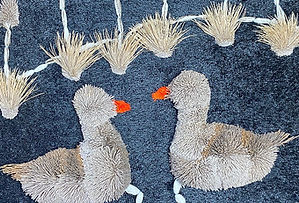
By tying small strips of moose and caribou hair onto a background to a desired pattern or shape, I then trim the hair in the shape of a duck, wolf, bear, person, or other figure. Bit by bit the vision in my head transforms the hair into a textured three dimensional image that stirs emotions.
My hope is that by displaying and teaching Tufting Art, it touches the soul, bringing an admiration for nature and a respect for everything, especially our rich native culture here in Canada.
Nature
Mother Earth
Healing
Emotion
Memory
Culture
Spirituality
Collection
Featured Tufting Artwork
Each piece is handcrafted from natural moose and caribou hair, taking weeks to complete.


.jpg)
.jpg)
.jpg)

.jpg)
.jpg)
Traditional Instruments
Handcrafted Traditional Drums
Each drum is hand-stretched, hand-painted, and imbued with cultural significance.


Commissions
Create a One-of-a-Kind Piece
Some of these are available for purchase and some are samples of the type of art that can be commissioned. If you are interested in purchasing a Tufting or have something in mind for a piece that you would like please contact me.
Commission custom wildlife scenes, personal memories, flowers, nature scenes, or traditional Indigenous-inspired artwork — each one handcrafted specifically for you.
.jpg)

.jpg)

The Process
From Nature to Finished Artwork
Every piece begins with raw natural materials and weeks of painstaking handwork.
01
Preparing the Hair
Picking moose hair from the hide by hand, selecting only the finest long winter hairs.
04
Drawing
Sketching the design — a scene from nature, memory, or imagination.
07
Finishing
02
Cleaning
Carefully washing and cleaning each strand to ensure purity and quality.
05
Tufting
Tying small strips of hair onto the background using precise, patient technique.
03
Sorting
Sorting the hair by length, texture, and colour for the perfect composition.
06
Trimming
Shaping the tufted hair into the desired forms — ducks, wolves, bears, flowers.
Final inspection and framing of the completed three-dimensional artwork.
Cultural Significance
Why Tufting Matters

Rare Indigenous Tradition
One of the rarest art forms in Canada, practiced by fewer than five artists in the world today.

Natural Materials
Crafted entirely from moose and caribou hair, using techniques passed down through generations.

Handcrafted Process
Every piece is painstakingly tied, trimmed, and shaped by hand — no machines, no shortcuts.

Passing Knowledge Forward
Derrick Hewitt teaches this art to ensure future generations can carry the tradition forward.
Services
What We Offer
.png)
Commissioned Artwork
Custom tufting pieces crafted to your vision — wildlife, flowers, nature, and personal memories.

Traditional Drum Making
Handcrafted and hand-painted traditional drums with original designs.

Teaching & Workshops
Learn the art of tufting directly from Derrick Hewitt in intimate workshop settings.

Cultural Presentations
Educational presentations about the history and craft of this rare Indigenous art form.
.png)
.png)
.png)